
The Maduro Raid

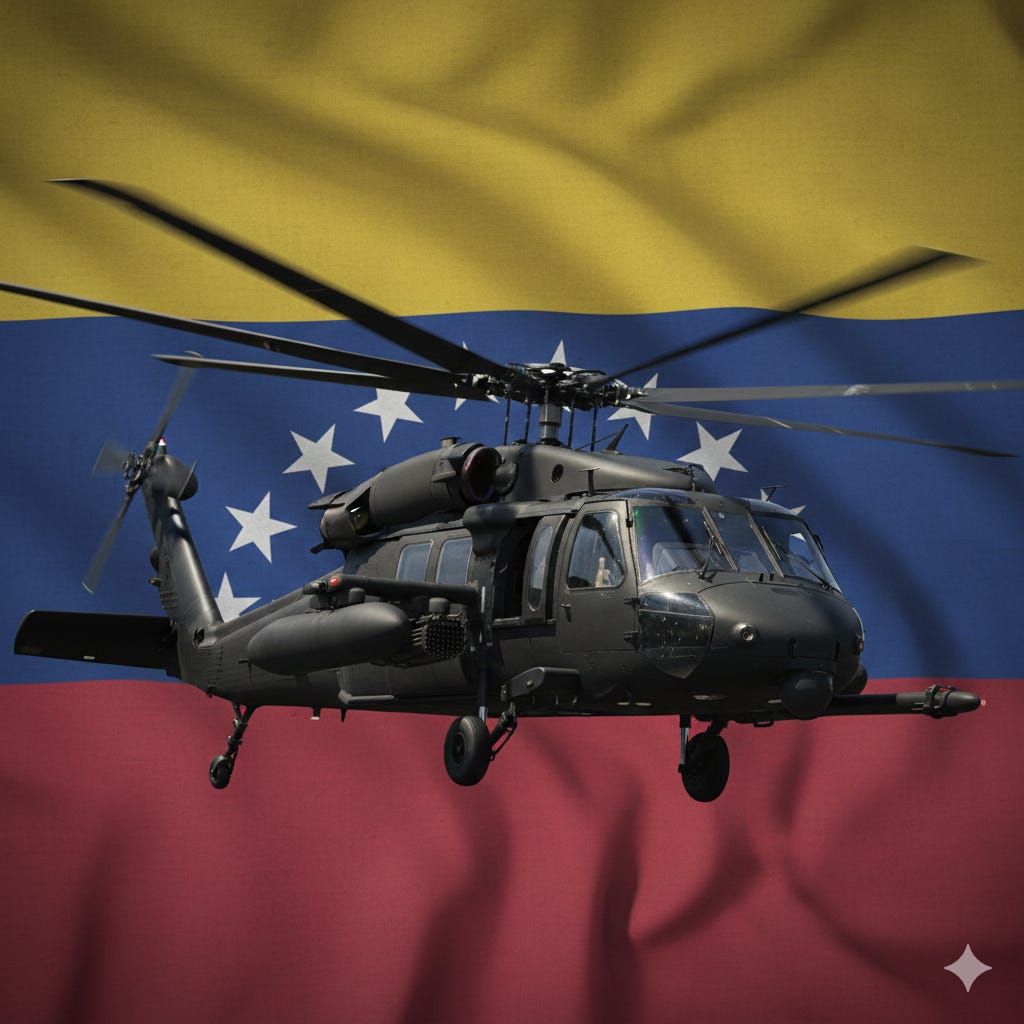
Happy New Year everyone! We are not even a week into the new year, but what a week it has been! There have been some big happenings in Venezuela, Iran, and … Minnesota. I will address each of these with their own post, but in this post, I want to reflect on events in Venezuela.
Late last month, a former student had emailed me asking my thoughts on Venezuela. I had been thinking of America’s buildup of mostly Navy assets in waters adjacent to Venezuela, and its attacks on alleged drug smuggling boats. My student’s email prompted me to write a brief essay trying to make sense of things. It was clear that America was asserting direct pressure on the authoritarian Maduro government, but why – or why now – was the question I tried to address. I published that brief on Christmas morning, and you can read it here.
Just nine days later, of course, the US would launch limited airstrikes on the country and, quite shockingly, capture Venezuela’s authoritarian ruler, Nicolás Maduro and his wife in a daring raid and whisk them out of the country.
It had all happened in the dead of night.
Now comes the aftermath.
Critics in America and abroad argue that the Maduro Raid was illegal. Snatching the head of state of a sovereign country is illegal and undermines peace and security. Invading a neighboring country, or a country in your neighborhood, gives cover and support to authoritarian countries like Russia, who invaded and occupies parts of Ukraine, and China, which threatens daily to invade and annex Taiwan. The raid is illegal in terms of international law and therefore frees other countries to also ignore and thumb their nose at international law. Such an action threatens to unravel the whole global order.
The thing is, the global order is already in flux due in large part to the proliferation of technology. Over the last 50 years, China liberalized its economy and transitioned from a deeply impoverished peasant-based country to a military and technological peer of the United States – without liberalizing politically. Europe rebuilt from World War II long ago and yet, despite also being modern industrialized and complex economies on par with the United States, they continue to rely on American defense and leadership in European affairs.
America, meanwhile, has stumbled badly in recent decades. The George W. Bush Administration’s decision to invade Iraq in 2003 was predictably disastrous, as was its transition from supporting the Northern Alliance in Afghanistan with airpower following the 9/11 terrorist attacks to physically occupying the country for twenty years and failing to defeat the Taliban.
Then came the financial meltdown in 2008 and the lost decade of the Great Recession, plus 40 years and counting of growing income disparities in the United States to grotesque levels. The uneven geographies of lost jobs in manufacturing and new jobs in services in select areas of the country – mostly along the coasts – have, in turn, produced political instability not seen since perhaps the 1960s or even the 1860s.
The protestations outlined above are salient. But the world order that the Maduro Raid is said to undermine is an American world order built after World War II to facilitate interconnectivity and interdependency among liberal democracies through global trade. The idea is that increased trade and interconnectedness reduces the potential for another devastating world war, particularly in Europe. That idea lives and is worth pursuing. But the rise of an illiberal China, the resurgence of an illiberal Russia (although it has largely failed in its objectives in its war in Ukraine), the spread of violent Islamism, and nuclear proliferation to belligerent countries like North Korea and Iran, not to mention the global collapse in legitimacy for the globalization project following the Great Recession, all challenge the American world order.
The chief responsibility of any state is security. Why should the United States tolerate – at the expense of its own security – authoritarian regimes in its own hemisphere that are aligned with the very powers above that are working to unravel the American world order, especially when that world order is more brittle than at any time since its creation? Venezuela has allowed Iran to open shop there and skirt Western sanctions. Venezuela flaunts Western sanctions on Iran, Russia, and North Korea, shipping oil to all them and Cuba. Maduro represses political opposition and, by all accounts, stole last year’s election. None of this helps Venezuelans. The country was, in fact, one of the most economically advanced in all of South America before Hugo Chavez ascended in 1999. Inequality was severe and Hugo Chavez aimed to narrow the gap between rich and poor, and he did make some headway – but those days are long gone. The country today is impoverished and its economic outlook is bleak – that is, before the Maduro raid.
Another critique leveled against the Maduro Raid is that the decapitation of Venezuela’s government will lead to chaos. They point to Libya and Iraq as recent examples. I am not sure that these examples are applicable. Both of those countries are in regions wracked by violent Islamism, and both countries were led by secular strongmen. By removing them, violent religious extremists flooded into the void. In contrast, Venezuela is a Western, predominately Catholic, country. Even ideology isn’t, or shouldn’t, be a factor. Communism has been delegitimized around the world, and most recently by Maduro himself.
That doesn’t mean that chaos won’t ensue. Venezuela is a deeply polarized country, more so than the United States. There may be political violence. Criminal gangs may run roughshod over the country.
The United States did not dismantle the Venezuelan government, however, and its military remains fully intact. In this case, the US might be avoiding the disastrous decision to dissolve the Iraqi military and ban all Baathists from government service in Iraq following the US invasion there. We will have to wait and see what comes next in Venezuela. I do think there is reason to hope for a rather mild transition to democratic norms and economic recovery.
Attention will now turn to Cuba. That country remains committed to one-party governance even 25 years after the collapse of the Soviet Union, which served as Cuba’s main political sponsor and economic lifeline. Just last year, Russia renewed its military cooperation pact with Cuba.
My final thought: Israel proved that authoritarian states can be way frailer than they appear. Israel severely weakened Hamas and Hezbollah following the horrific attacks of October 7, 2023. The Bashar Assad regime in neighboring Syria, which sponsored Hezbollah and leaned on them heavily during their civil war, collapsed suddenly in December 2024. This past summer, Israel and the US launched devastating airstrikes on Iran, including against its nuclear program, following Tehran’s ballistic missile attacks on Israel. Now Iran is roiling. It might even be on the brink of collapse after nine days of popular rebellion. Further, the regime in Tehran continues to remain belligerent against both Israel and the United States and is defiantly rebuilding its nuclear program. US forces are gathering.
In Venezuela, and possibly elsewhere, the US may be taking a page out of Israel’s playbook: strike while the iron is hot.
Mark James is the Kirkus-starred author of geopolitical thrillers Friendship Games and The Compass Room. He has taught political and economic geography for over the twenty years.